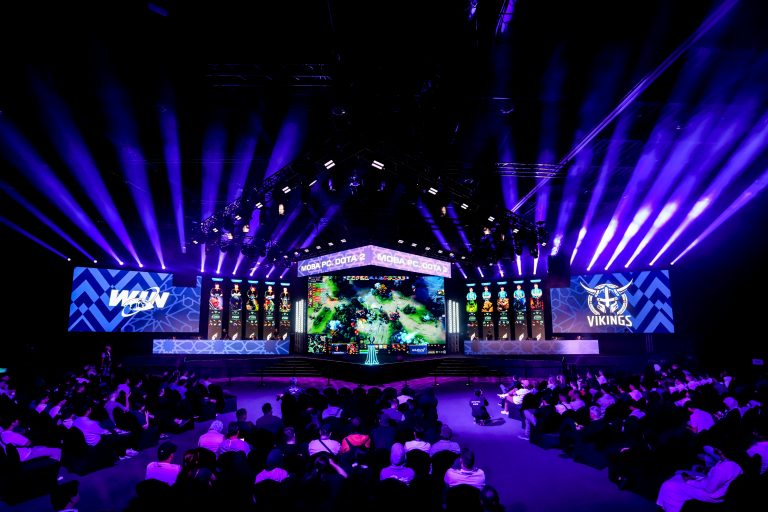


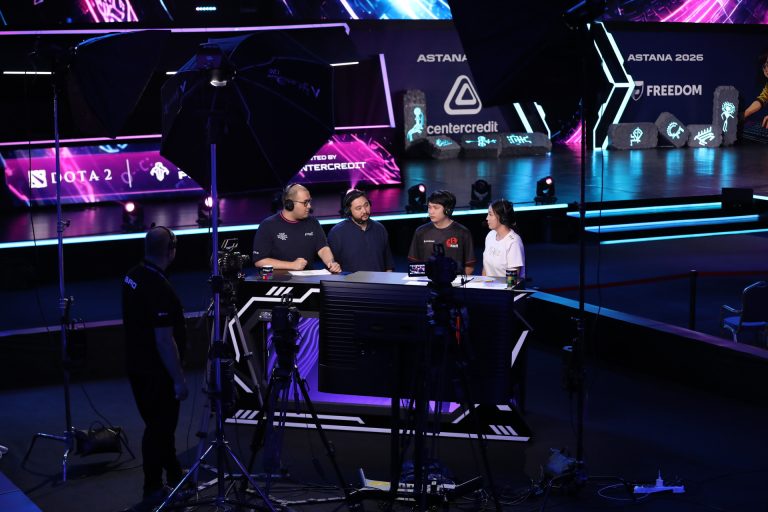
This year’s Games of the Future (GOTF) in Astana looked amazing on screen, but the real magic happened behind it.
The second edition of the tournament once again saw athletes and teams from around the world come together, this time to compete in eight disciplines across 12 days of competition. For the teams responsible for producing and distributing the event, the challenge was to build a broadcast operation capable of reaching a much larger and more diverse audience while adapting to the very different demands of phygital sport.
That meant thinking beyond a traditional sports broadcast.
In Astana, the Games reached more than 150 countries and territories across 20-plus languages, up from 86 distribution outlets in 2025 to 289 this year. That network was built on 56 media rights companies, 229 community streamers and four owned channels.
The growth was particularly visible in Asia, the Americas, and the host market. Huya, BiliBili and DouYu all carried the event simultaneously in China, while MBC, StarTimes, Disney APAC and DirecTV extended its reach across major international markets.
The clearest sign of that growth, though, was closer to home: in Kazakhstan, 13 local channels and platforms carried the games this year, compared with a single local partner at the 2025 event in Abu Dhabi.
But the numbers only tell part of the story.
A different approach to sports production
Games of the Future combines two very different production environments: the physical stage and the digital competition.
Physical disciplines are produced using traditional sports broadcasting techniques, while digital stages rely on specialist in-game observers who follow the action from spectator’s side[SL1.1][AK1.2]. Bringing both sides together requires a shared graphics language, a consistent dual scoreline and a production approach that makes the two parts feel like one competition.
A key part of that approach is the “Phygital Universe”, a dedicated virtual world that provides a unifying layer across the different disciplines. It has become an integral part of the Games of the Future product, giving viewers one coherent world to return to as the broadcast moves between sports.
Data played a bigger role across the event too. Official match data collected and provided by the Games of the Future’s proprietary technology platform opened new possibilities for live statistics – while the Games’ virtual world connected the different disciplines and created new opportunities for commercial integrations.
The physical-digital blend also showed up in smaller, more visible ways. In Phygital Shooter, for example, real-time capture from the laser-tag matches could be brought into the broadcast, creating visuals that closely connect the physical action with the digital game. The LED floor used for basketball also added a distinctly digital feel to the physical stage.
From broadcast to a global content network
Another major development was the expansion of community streaming.
The number of creators grew from 58 in 2025 to 229 in Astana, with a combined verified reach of 56.1 million followers across 36 countries. Six community streamers travelled to Astana to produce content directly from the venues, alongside five international media rights partners producing their own coverage on site.
At the same time, Phygital+ carried every discipline live and on demand, giving Games of the Future its own direct connection with audiences alongside traditional broadcasters such as YouTube and Twitch.
The production infrastructure behind all of this has also evolved. A central distribution and asset management system allows the event to manage streams, signals and delivery to hundreds of outlets, while keeping the core distribution operation consistent from one edition to the next.
That is perhaps the most important development of all. Games of the Future is no longer simply producing a broadcast for an event – it is building a broadcasting model around the way phygital sport is watched. And with vertical live content already being considered for the next edition, that model will keep evolving.